
Why AI-Integrated Marketing is the Only Strategy for 2026
Introductory Paragraph
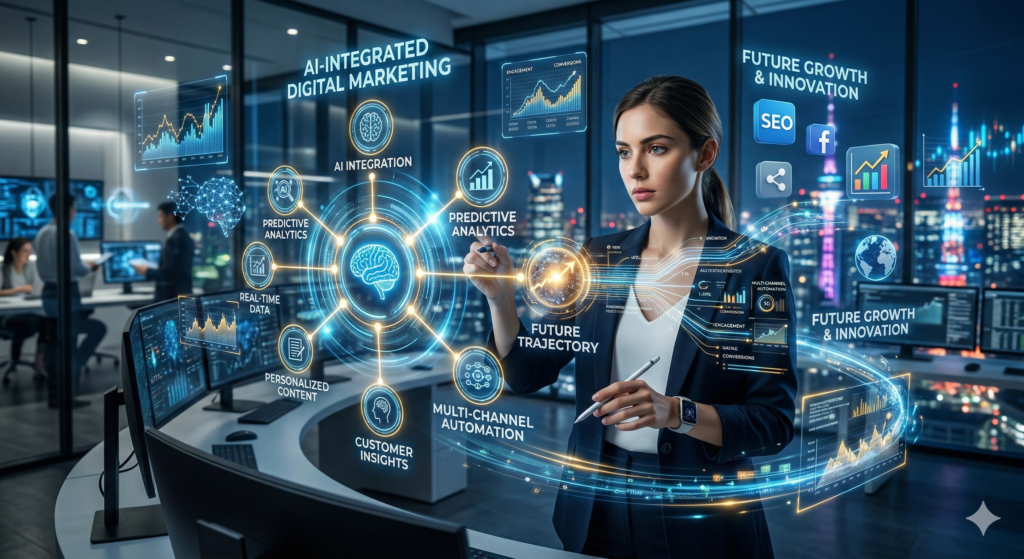
Digital marketing is no longer a game of manual adjustments and broad demographics; it has evolved into a high-speed, intelligent ecosystem. In 2026, the “AI-integrated” approach isn’t just about generating text or images—it’s about using Agentic AI and Predictive Analytics to build a seamless, one-to-one connection with every single customer. As traditional search engines transition into “Answer Engines,” marketers must pivot from keyword-stuffing to Generative Engine Optimization (GEO). This blog explores how AI is reshaping the industry and why human creativity remains the ultimate “vibe director” in an automated world.
Main Points & Detailed Explanation
1. The Shift to Hyper-Personalization
In 2026, “personalization” means more than just a name in an email. AI now analyzes real-time browsing habits, sentiment, and even current location to deliver unique website experiences for every visitor.
The Core Concept: Companies are moving away from broad “segments” to individual “journeys.”
Why it Matters: AI-driven personalization can increase conversion rates by up to 136%, as it provides the right offer at the exact moment a customer is ready to buy.
2. From SEO to GEO (Generative Engine Optimization)
The era of the “blue link” is fading. With the rise of AI summaries and conversational assistants, brands now need to optimize for how AI systems understand and cite information.
The Core Concept: Instead of targeting keywords, you must build Entity-Based Authority. This means being recognized as a credible source by LLMs (Large Language Models).
Why it Matters: By 2026, over 25% of organic traffic is expected to shift directly to AI chatbots. If your content isn’t “AI-readable” and structured correctly, your brand becomes invisible.
3. Agentic AI: The New Marketing Workforce
We have moved past simple automation (scheduling posts) to Agentic AI—autonomous systems that can research, plan, and execute entire multi-channel campaigns with minimal supervision.
The Core Concept: AI “agents” now handle complex workflows like real-time bid adjustments in ads, A/B testing thousands of creative variations, and proactive lead nurturing.
Why it Matters: Marketers who use AI as an “orchestrator” save an average of 11 hours per week, allowing them to focus on high-level strategy and brand storytelling.
4. The Human Element: The “Vibe Director”
As AI becomes a commodity, the “human touch” becomes the premium. The future of marketing belongs to those who can direct AI to maintain an authentic brand voice.
The Core Concept: AI can scale content, but it cannot feel, observe, or interpret cultural nuances with genuine empathy.
Why it Matters: Authentic, human-led storytelling is the only way to build long-term trust in an era where consumers are increasingly wary of “mechanical” or “hollow” AI-generated content.
Conclusion & Key Takeaway
The future of digital marketing isn’t a battle between humans and machines; it’s a partnership. In 2026, the most successful marketers are AI Orchestrators—professionals who use technology to handle the data-heavy “heavy lifting” while they provide the strategic vision, ethical oversight, and creative spark that machines simply cannot replicate.
Introductory Paragraph
Digital marketing is no longer a game of manual adjustments and broad demographics; it has evolved into a high-speed, intelligent ecosystem. In 2026, the “AI-integrated” approach isn’t just about generating text or images—it’s about using Agentic AI and Predictive Analytics to build a seamless, one-to-one connection with every single customer. As traditional search engines transition into “Answer Engines,” marketers must pivot from keyword-stuffing to Generative Engine Optimization (GEO). This blog explores how AI is reshaping the industry and why human creativity remains the ultimate “vibe director” in an automated world.
Main Points & Detailed Explanation
1. The Shift to Hyper-Personalization
In 2026, “personalization” means more than just a name in an email. AI now analyzes real-time browsing habits, sentiment, and even current location to deliver unique website experiences for every visitor.
The Core Concept: Companies are moving away from broad “segments” to individual “journeys.”
Why it Matters: AI-driven personalization can increase conversion rates by up to 136%, as it provides the right offer at the exact moment a customer is ready to buy.
2. From SEO to GEO (Generative Engine Optimization)
The era of the “blue link” is fading. With the rise of AI summaries and conversational assistants, brands now need to optimize for how AI systems understand and cite information.
The Core Concept: Instead of targeting keywords, you must build Entity-Based Authority. This means being recognized as a credible source by LLMs (Large Language Models).
Why it Matters: By 2026, over 25% of organic traffic is expected to shift directly to AI chatbots. If your content isn’t “AI-readable” and structured correctly, your brand becomes invisible.
3. Agentic AI: The New Marketing Workforce
We have moved past simple automation (scheduling posts) to Agentic AI—autonomous systems that can research, plan, and execute entire multi-channel campaigns with minimal supervision.
The Core Concept: AI “agents” now handle complex workflows like real-time bid adjustments in ads, A/B testing thousands of creative variations, and proactive lead nurturing.
Why it Matters: Marketers who use AI as an “orchestrator” save an average of 11 hours per week, allowing them to focus on high-level strategy and brand storytelling.
4. The Human Element: The “Vibe Director”
As AI becomes a commodity, the “human touch” becomes the premium. The future of marketing belongs to those who can direct AI to maintain an authentic brand voice.
The Core Concept: AI can scale content, but it cannot feel, observe, or interpret cultural nuances with genuine empathy.
Why it Matters: Authentic, human-led storytelling is the only way to build long-term trust in an era where consumers are increasingly wary of “mechanical” or “hollow” AI-generated content.
Conclusion & Key Takeaway
The future of digital marketing isn’t a battle between humans and machines; it’s a partnership. In 2026, the most successful marketers are AI Orchestrators—professionals who use technology to handle the data-heavy “heavy lifting” while they provide the strategic vision, ethical oversight, and creative spark that machines simply cannot replicate.
